Refactor the webhook logic, to have the type-dependent processing happen
only in one place.

---

## Current webhook flow

1. An event happens
2. It is pre-processed (depending on the webhook type) and its body is
added to a task queue
3. When the task is processed, some more logic (depending on the webhook
type as well) is applied to make an HTTP request

This means that webhook-type dependant logic is needed in step 2 and 3.
This is cumbersome and brittle to maintain.

Updated webhook flow with this PR:
1. An event happens
2. It is stored as-is and added to a task queue
3. When the task is processed, the event is processed (depending on the
webhook type) to make an HTTP request

So the only webhook-type dependent logic happens in one place (step 3)
which should be much more robust.

## Consequences of the refactor

- the raw event must be stored in the hooktask (until now, the
pre-processed body was stored)
- to ensure that previous hooktasks are correctly sent, a
`payload_version` is added (version 1: the body has already been
pre-process / version 2: the body is the raw event)

So future webhook additions will only have to deal with creating an
http.Request based on the raw event (no need to adjust the code in
multiple places, like currently).

Moreover since this processing happens when fetching from the task
queue, it ensures that the queuing of new events (upon a `git push` for
instance) does not get slowed down by a slow webhook.

As a concrete example, the PR #19307 for custom webhooks, should be
substantially smaller:
- no need to change `services/webhook/deliver.go`
- minimal change in `services/webhook/webhook.go` (add the new webhook
to the map)
- no need to change all the individual webhook files (since with this
refactor the `*webhook_model.Webhook` is provided as argument)
Fixes#24145
To solve the bug, I added a "computed" `TargetBehind` field to the
`Release` model, which indicates the target branch of a release.
This is particularly useful if the target branch was deleted in the
meantime (or is empty).
I also did a micro-optimization in `calReleaseNumCommitsBehind`. Instead
of checking that a branch exists and then call `GetBranchCommit`, I
immediately call `GetBranchCommit` and handle the `git.ErrNotExist`
error.
This optimization is covered by the added unit test.
_This is a different approach to #20267, I took the liberty of adapting
some parts, see below_
## Context
In some cases, a weebhook endpoint requires some kind of authentication.
The usual way is by sending a static `Authorization` header, with a
given token. For instance:
- Matrix expects a `Bearer <token>` (already implemented, by storing the
header cleartext in the metadata - which is buggy on retry #19872)
- TeamCity #18667
- Gitea instances #20267
- SourceHut https://man.sr.ht/graphql.md#authentication-strategies (this
is my actual personal need :)
## Proposed solution
Add a dedicated encrypt column to the webhook table (instead of storing
it as meta as proposed in #20267), so that it gets available for all
present and future hook types (especially the custom ones #19307).
This would also solve the buggy matrix retry #19872.
As a first step, I would recommend focusing on the backend logic and
improve the frontend at a later stage. For now the UI is a simple
`Authorization` field (which could be later customized with `Bearer` and
`Basic` switches):
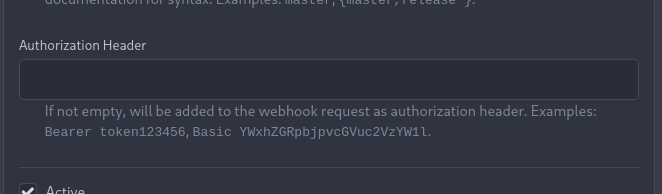
The header name is hard-coded, since I couldn't fine any usecase
justifying otherwise.
## Questions
- What do you think of this approach? @justusbunsi @Gusted @silverwind
- ~~How are the migrations generated? Do I have to manually create a new
file, or is there a command for that?~~
- ~~I started adding it to the API: should I complete it or should I
drop it? (I don't know how much the API is actually used)~~
## Done as well:
- add a migration for the existing matrix webhooks and remove the
`Authorization` logic there
_Closes #19872_
Co-authored-by: Lunny Xiao <xiaolunwen@gmail.com>
Co-authored-by: Gusted <williamzijl7@hotmail.com>
Co-authored-by: delvh <dev.lh@web.de>

 oliverpoolandGitHub