1. Use general "mobile-only" and "not-mobile" CSS styles, remove some`@media (max-width: 767.98px)` tricks
2. Use `CountFmt` for repo list, just like the repo header (and it matches GitHub, to avoid big numbers bloat the page)
1. The borders were doubled on the "empty" page, fix it.
2. Remove unnecessary CSS classes like "clone", "compact", etc
3. Use CSS class "clone-panel" instead of ID "clone-panel"
4. Use `tw-flex-1` instead of `gt-f1`
5. Remove unnecessary ID "more-btn"
When read the code: `pager.AddParam(ctx, "search", "search")`, the
question always comes: What is it doing? Where is the value from? Why
"search" / "search" ?

Now it is clear: `pager.AddParamIfExist("search", ctx.Data["search"])`
There is a fundamental design problem of the "manager" and the "wait
group".
If nothing has started, the "Wait" just panics: sync: WaitGroup is
reused before previous Wait has returned
There is no clear solution besides a complete rewriting of the "manager"

If there are some mistakes in the app.ini, end users would just see the
"panic", but not the real error messages. A real case: #27643

This PR is just a quick fix for the annoying panic problem.
Follow #29418

I think using "flex-wrap: wrap" here is better than hard-coding the screen width.

By using "flex-wrap: wrap", the UI layouts automatically for various
widths (even if in some languages, the sentence might be pretty long)
* "mail/issue/default.tmpl": the body is rendered by backend
`markdown.RenderString() HTML`, it has been already sanitized
* "repo/settings/webhook/base_list.tmpl": "Description" is prepared by
backend `ctx.Tr`, it doesn't need to be sanitized
Without `case <-t.C`, the workers would stop incorrectly, the test won't
pass. For the worse case, there might be only one running worker
processing the queue items for long time because other workers are
stopped. The root cause is related to the logic of doDispatchBatchToWorker.
It isn't a serious problem at the moment, so keep it as-is.
To avoid conflicting with User.GetDisplayName, because there is no data
type in template.

And it matches other methods like GetActFullName / GetActUserName
* `$referenceUrl`: it is constructed by "Issue.Link", which already has
the "AppSubURL"
* `window.location.href`: AppSubURL could be empty string, so it needs
the trailing slash
* Follow #17746: `HasIssueContentHistory` should use expr builder to
make sure zero value (0) be respected.
* Add "doer" check to make sure `canSoftDeleteContentHistory` only be
called by sign-in users.
The value passed into "attachments" sub-template is from
"RedneredContent", so use the same name for consistent. And it makes
readers easy to know its data type.
This PR touches the most interesting part of the "template refactoring".

1. Unclear variable type. Especially for "web/feed/convert.go":
sometimes it uses text, sometimes it uses HTML.
2. Assign text content to "RenderedContent" field, for example: `
project.RenderedContent = project.Description` in web/org/projects.go
3. Assign rendered content to text field, for example: `r.Note =
rendered content` in web/repo/release.go
4. (possible) Incorrectly calling `{{Str2html
.PackageDescriptor.Metadata.ReleaseNotes}}` in
package/content/nuget.tmpl, I guess the name Str2html misleads
developers to use it to "render string to html", but it only sanitizes.
if ReleaseNotes really contains HTML, then this is not a problem.
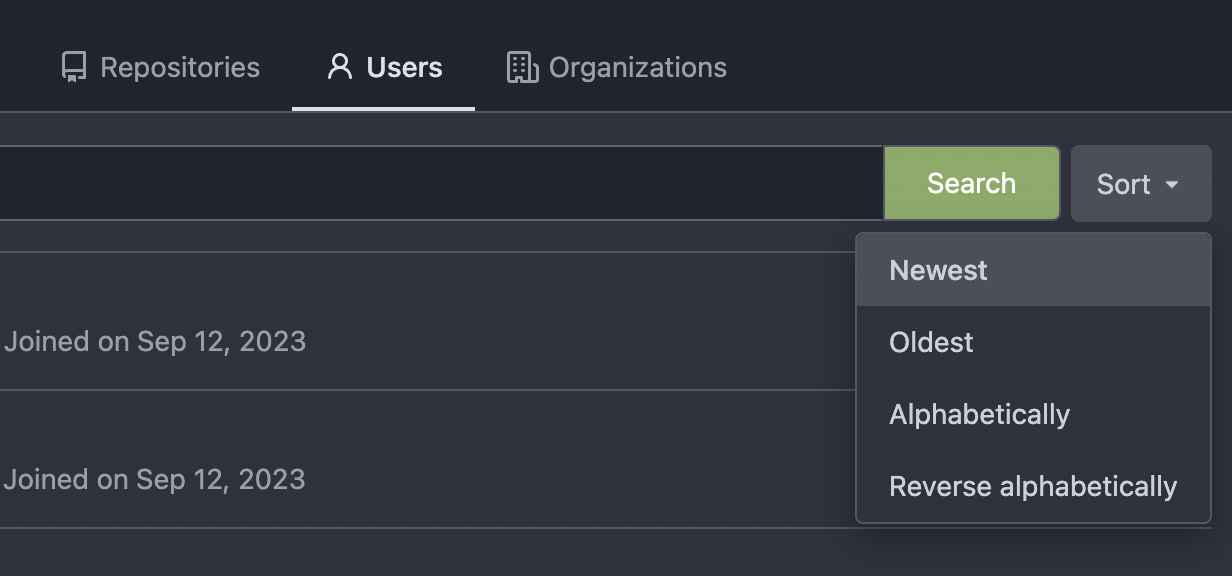
Thanks to inferenceus : some sort orders on the "explore/users" page
could list users by their lastlogintime/updatetime.
It leaks user's activity unintentionally. This PR makes that page only
use "supported" sort orders.
Removing the "sort orders" could also be a good solution, while IMO at
the moment keeping the "create time" and "name" orders is also fine, in
case some users would like to find a target user in the search result,
the "sort order" might help.
Regression of #18718. When submitting the form,
EditRepoFileForm.TreePath is marked as "Required", so the value can't be
empty. The value is not used by backend, so use a meaningful dummy value
for it.
Follow #29165

* some of them are incorrect, which would lead to double escaping (eg:
`(print (Escape $.RepoLink)`)
* other of them are not necessary, because `Tr` handles strings&HTML
automatically

Suggest to review by "unified view":
https://github.com/go-gitea/gitea/pull/29394/files?diff=unified&w=0
The citiation button shouldn't be controlled by
DisableDownloadSourceArchives (line 134)

So move it out of that "if" block.

Co-authored-by: Giteabot <teabot@gitea.io>
RenderEmojiPlain(emoji.ReplaceAliases) should be called explicitly for
some contents, but not for everything.

Actually in modern days, in most cases it doesn't need such
"ReplaceAliases". So only keep it for issue/PR titles.

If anyone really needs to do ReplaceAliases for some contents, I will
propose a following fix.
* use `setup(ctx, c.Bool("debug"))` like all other callers
* `setting.RunMode = "dev"` is a no-op.
* `if _, err := os.Stat(setting.RepoRootPath); err != nil` could be
simplified
Follow #29024

Major changes:

* refactor validLinksPattern to fullURLPattern and add comments, now it
accepts "protocol:" prefix
* rename `IsLink*` to `IsFullURL*`, and remove unnecessray "mailto:"
check
* fix some comments (by the way)
* rename EmojiShortCodeRegex -> emojiShortCodeRegex (by the way)
Follow #29165.

* Introduce JSONTemplate to help to render JSON templates
* Introduce JSEscapeSafe for templates. Now only use `{{ ... |
JSEscape}}` instead of `{{ ... | JSEscape | Safe}}`
* Simplify "UserLocationMapURL" useage
Old code is not consistent for generating & decoding the JWT secrets.

Now, the callers only need to use 2 consistent functions:
NewJwtSecretWithBase64 and DecodeJwtSecretBase64

And remove a non-common function Base64FixedDecode from util.go
Clarify when "string" should be used (and be escaped), and when
"template.HTML" should be used (no need to escape)

And help PRs like  #29059 , to render the error messages correctly.
Introduce a new function checkGitVersionCompatibility, when the git
version can't be used by Gitea, tell the end users to downgrade or
upgrade. The refactored functions are related to make the code easier to
test.

And simplify the comments for "safe.directory"

---------

Co-authored-by: delvh <dev.lh@web.de>
The old code `GetTemplatesFromDefaultBranch(...) ([]*api.IssueTemplate,
map[string]error)` doesn't really follow Golang's habits, then the
second returned value might be misused. For example, the API function
`GetIssueTemplates` incorrectly checked the second returned value and
always responds 500 error.

This PR refactors GetTemplatesFromDefaultBranch to
ParseTemplatesFromDefaultBranch and clarifies its behavior, and fixes the
API endpoint bug, and adds some tests.

And by the way, add proper prefix `X-` for the header generated in
`checkDeprecatedAuthMethods`, because non-standard HTTP headers should
have `X-` prefix, and it is also consistent with the new code in
`GetIssueTemplates`
Replace #28849. Thanks to @yp05327 for the looking into the problem.
Fix#28840
The old behavior of newSignatureFromCommitline is not right. The new
parseSignatureFromCommitLine:
1. never fails
2. only accept one format (if there is any other, it could be easily added)
And add some tests.
Try to improve #28949

1. Make `ctx.Data["ShowOutdatedComments"] = true` by default: it brings
consistent user experience, and sometimes the "outdated (source
changed)" comments are still valuable.
2. Show a friendly message if the comment won't show, then the end users
won't fell that "the comment disappears" (it is the special case when
`ShowOutdatedComments = false`)
Follow #28654

The `comments` might be empty, so the templates shouldn't (and couldn't)
use it to render. When there is no comment, the UI should also be
updated to empty, so returning an empty body is good enough.
Gitea treat JS errors seriously, so sometimes the JS errors caused by
3rdparty code (eg: browser extensions) would also be reported on Gitea
UI: TypeError: WeakMap key undefined (caused by extension DarkReader's
bug) #28861

To avoid fill the user's screen with a lot of error messages, this PR
merges the same error messages into one, like this:

```js
<div class="page-content">
  <div class="... js-global-error" data-global-error-msg-compact="testmsg1" data-global-error-msg-count="2">test msg 1 (2)</div>
  <div class="... js-global-error" data-global-error-msg-compact="testmsg2" data-global-error-msg-count="1">test msg 2</div>
</div>
```
Mainly for MySQL/MSSQL.
It is important for Gitea to use case-sensitive database charset
collation. If the database is using a case-insensitive collation, Gitea
will show startup error/warning messages, and show the errors/warnings
on the admin panel's Self-Check page.
Make `gitea doctor convert` work for MySQL to convert the collations of
database & tables & columns.
* Fix#28131
## ⚠️ BREAKING ⚠️
It is not quite breaking, but it's highly recommended to convert the
database&table&column to a consistent and case-sensitive collation.
Gitea prefers to use relative URLs in code (to make multiple domain work
for some users)

So it needs to use `toAbsoluteUrl` to generate a full URL when click
"Reference in New Issues"

And add some comments in the test code
In #26851, it assumed that `Commit` always exists when
`PageIsDiff==true`.

But for a 404 page, the `Commit` doesn't exist, so the following code
would cause panic because nil value can't be passed as string parameter
to `IsMultilineCommitMessage(string)` (or the StringUtils.Cut in later
PRs)
 wxiaoguang


